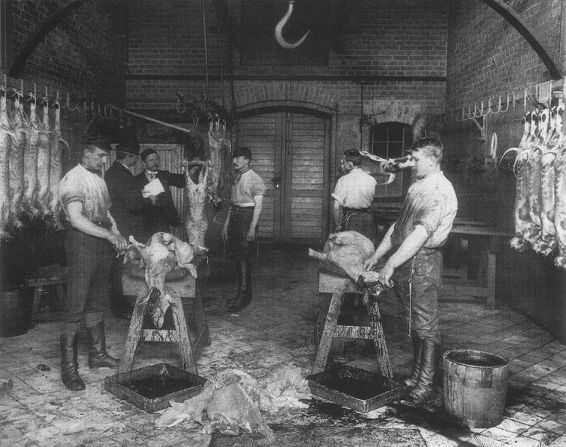
Holding: The grant of exclusive right or privilege within the power of the state legislatures is unaffected by the Constitution of the United States’ adoption of the thirteenth and fourteenth articles of amendment. The Thirteenth Amendment abolishes slavery, only. Privileges and immunities of the Fourteenth Amendment do not hand over control over all civil rights from the states to the federal government.
Result: The Louisanna Act that created a corporation and gave it monopoly power for butchery did not violate the rights of other butchers. In the first case where the Supreme Court was called upon to interpret the Reconstruction Amendments, in addition to the holding, the majority opinion confined the meaning of the Thirteenth Amendment to the abolition of slavery only and interpreted the Fourteenth Amendment as an obligation upon states to provide equal treatment for citizens of other states.
Jurisprudence: Contextualism
ERROR TO THE SUPREME COURT OF LOUISIANA
Mr. Justice MILLER, now, April 14th, 1873, delivered the opinion of the court.
These cases are brought here by writs of error to the Supreme Court of the State of Louisiana. They arise out of the efforts of the butchers of New Orleans to resist the Crescent City Livestock Landing and Slaughter-House Company [(Slaughter-House Company)] in the exercise of certain powers conferred by the charter which created it, and which was granted by the legislature of that State.
[…] (Page 83 U. S. 58)
The records show that the plaintiffs in error relied upon, and asserted throughout the entire course of the litigation in the State courts, that the grant of privileges in the charter of defendant, which they were contesting, was a violation of the most important provisions of the thirteenth and fourteenth articles of amendment of the Constitution of the United States. The jurisdiction and the duty of this court (Page 83 U. S. 59) to review the judgment of the State court on those questions is clear, and is imperative.
The statute thus assailed as unconstitutional was passed March 8th, 1869, and is entitled
“An act to protect the health of the city of New Orleans, to locate the stock landings and slaughterhouses, and to incorporate the Crescent City Livestock Landing aud Slaughter-House Company.”
The first section forbids the landing or slaughtering of animals whose flesh is intended for food within the city of New Orleans and other parishes and boundaries named and defined, or the keeping or establishing any slaughterhouses or abattoirs within those limits except by the corporation thereby created, which is also limited to certain places afterwards mentioned. Suitable penalties are enacted for violations of this prohibition.
The second section designates the corporators, gives the name to the corporation, and confers on it the usual corporate powers.
The third and fourth sections authorize the company to establish and erect within certain territorial limits, therein defined, one or more stockyards, stock landings, and slaughterhouses, and imposes upon it the duty of erecting, on or before the first day of June, 1869, one grand slaughterhouse of sufficient capacity for slaughtering five hundred animals per day.
It declares that the company, after it shall have prepared all the necessary buildings, yards, and other conveniences for that purpose, shall have the sole and exclusive privilege of conducting and carrying on the livestock landing and slaughterhouse business within the limits and privilege granted by the act, and that all such animals shall be landed at the stock landings and slaughtered at the slaughterhouses of the company, and nowhere else. Penalties are enacted for infractions of this provision, and prices fixed for the maximum charges of the company for each steamboat and for each animal landed.
Section five orders the closing up of all other stock landings (Page 83 U. S. 60) and slaughterhouses after the first day of June, in the parishes of Orleans, Jefferson, and St. Bernard, and makes it the duty of the company to permit any person to slaughter animals in their slaughterhouses under a heavy penalty for each refusal. Another section fixes a limit to the charges to be made by the company for each animal so slaughtered in their building, and another provides for an inspection of all animals intended to be so slaughtered by an officer appointed by the governor of the State for that purpose.
These are the principal features of the statute, and are all that have any bearing upon the questions to be decided by us.
This statute is denounced not only as creating a monopoly and conferring odious and exclusive privileges upon a small number of persons at the expense of the great body of the community of New Orleans, but it is asserted that it deprives a large and meritorious class of citizens — the whole of the butchers of the city — of the right to exercise their trade, the business to which they have been trained and on which they depend for the support of themselves and their families, and that the unrestricted exercise of the business of butchering is necessary to the daily subsistence of the population of the city.
But a critical examination of the act hardly justifies these assertions.
It is true that it grants, for a period of twenty-five years, exclusive privileges. And whether those privileges are at the expense of the community in the sense of a curtailment of any of their fundamental rights, or even in the sense of doing them an injury, is a question open to considerations to be hereafter stated. But it is not true that it deprives the butchers of the right to exercise their trade, or imposes upon them any restriction incompatible with its successful pursuit, or furnishing the people of the city with the necessary daily supply of animal food.
The act divides itself into two main grants of privilege, the one in reference to stock landings and stockyards, and (Page 83 U. S. 61) the other to slaughterhouses. That the landing of livestock in large droves, from steamboats on the bank of the river, and from railroad trains, should, for the safety and comfort of the people and the care of the animals, be limited to proper places, and those not numerous it needs no argument to prove. Nor can it be injurious to the general community that, while the duty of making ample preparation for this is imposed upon a few men, or a corporation, they should, to enable them to do it successfully, have the exclusive right of providing such landing places, and receiving a fair compensation for the service.
It is, however, the slaughterhouse privilege which is mainly relied on to justify the charges of gross injustice to the public and invasion of private right.
It is not, and cannot be successfully controverted that it is both the right and the duty of the legislative body — the supreme power of the State or municipality — to prescribe and determine the localities where the business of slaughtering for a great city may be conducted. To do this effectively, it is indispensable that all persons who slaughter animals for food shall do it in those places and nowhere else.
The statute under consideration defines these localities and forbids slaughtering in any other. It does not, as has been asserted, prevent the butcher from doing his own slaughtering. On the contrary, the Slaughter-House Company is required, under a heavy penalty, to permit any person who wishes to do so to slaughter in their houses, and they are bound to make ample provision for the convenience of all the slaughtering for the entire city. The butcher then is still permitted to slaughter, to prepare, and to sell his own meats; but he is required to slaughter at a specified place, and to pay a reasonable compensation for the use of the accommodations furnished him at that place.
[…]
The power here exercised by the legislature of Louisiana is, in its essential nature, one which has been, up to the present period in the constitutional history of this country, always conceded to belong to the States, however it may now be questioned in some of its details.
“Unwholesome trades, slaughterhouses, operations offensive to the senses, the deposit of powder, the application of steam power to propel cars, the building with combustible materials, and the burial of the dead, may all,”
says Chancellor Kent, [Footnote 2]
“be interdicted by law, in the midst of dense masses of population, on the general and rational principle that every person ought so to use his property as not to injure his neighbors, and that private interests must be made subservient to the general interests of the community.”
This is called the police power, and it is declared by Chief Justice Shaw [Footnote 3] that it is much easier to perceive and realize the existence and sources of it than to mark its boundaries, or prescribe limits to its exercise.
This power is, and must be from its very nature, incapable of any very exact definition or limitation. Upon it depends the security of social order, the life and health of the citizen, the comfort of an existence in a thickly populated community, the enjoyment of private social life, and the beneficial use of property. “It extends,” says another eminent judge, [Footnote 4]
“to the protection of the lives, limbs, health, comfort, and quiet of all persons, and the protection of all property within the State, . . . and persons and property are subjected to all kinds of restraints and burdens in order to secure the general comfort, health, and prosperity of the State. Of the perfect right of the legislature to do this, no question ever was, or, upon acknowledged general principles, ever can be made, so far as natural persons are concerned. ” (Page 83 U. S. 63)
The regulation of the place and manner of conducting the slaughtering of animals, and the business of butchering within a city, and the inspection of the animals to be killed for meat, and of the meat afterwards, are among the most necessary and frequent exercises of this power. It is not, therefore, needed that we should seek for a comprehensive definition, but rather look for the proper source of its exercise.
[… citing Gibbons v. Ogden, [Footnote 5] ]
The exclusive authority of State legislation over this subject is strikingly illustrated in the case of the City of New York v. Miln. [Footnote 6] In that case, the defendant was prosecuted for failing to comply with a statute of New York which required of every master of a vessel arriving from a foreign port in that of New York City to report the names of all his passengers, with certain particulars of their age, occupation, last place of settlement, and place of their birth. It was argued that this act was an invasion of the exclusive right of Congress to regulate commerce. And it cannot be denied that such a statute operated at least indirectly upon the commercial intercourse between the citizens of the United States and of foreign countries. But notwithstanding this, it was held to be an exercise of the police power properly within the control of the State, and unaffected by the clause of the Constitution which conferred on Congress the right to regulate commerce. (Page 83 U. S. 64)
[…]
It cannot be denied that the statute under consideration is aptly framed to remove from the more densely populated part of the city the noxious slaughterhouses, and large and offensive collections of animals necessarily incident to the slaughtering business of a large city, and to locate them where the convenience, health, and comfort of the people require they shall be located. And it must be conceded that the means adopted by the act for this purpose are appropriate, are stringent, and effectual. But it is said that, in creating a corporation for this purpose, and conferring upon it exclusive privileges — privileges which it is said constitute a monopoly — the legislature has exceeded its power. If this statute had imposed on the city of New Orleans precisely the same duties, accompanied by the same privileges, which it has on the corporation which it created, it is believed that no question would have been raised as to its constitutionality. In that case the effect on the butchers in pursuit of their occupation and on the public would have been the same as it is now. Why cannot the legislature confer the same powers on another corporation, created for a lawful and useful public object, that it can on the municipal corporation already existing? That wherever a legislature has the right to accomplish a certain result, and that result is best attained by means of a corporation, it has the right to create such a corporation, and to endow it with the powers necessary to effect the desired and lawful purpose, seems hardly to admit of debate. The proposition is ably discussed and affirmed in the case of McCulloch v. The State of Maryland [Footnote 9] in relation to the power of Congress to organize (Page 83 U. S. 65) the Bank of the United States to aid in the fiscal operations of the government.
It can readily be seen that the interested vigilance of the corporation created by the Louisiana legislature will be more efficient in enforcing the limitation prescribed for the stock landing and slaughtering business for the good of the city than the ordinary efforts of the officers of the law.
Unless, therefore, it can be maintained that the exclusive privilege granted by this charter to the corporation is beyond the power of the legislature of Louisiana, there can be no just exception to the validity of the statute. And, in this respect, we are not able to see that these privileges are especially odious or objectionable. The duty imposed as a consideration for the privilege is well defined, and its enforcement well guarded. The prices or charges to be made by the company are limited by the statute, and we are not advised that they are, on the whole, exorbitant or unjust.
The proposition is therefore reduced to these terms: can any exclusive privileges be granted to any of its citizens, or to a corporation, by the legislature of a State?
[… (Page 83 U. S. 66)…]
But we think it may be safely affirmed that the Parliament of Great Britain, representing the people in their legislative functions, and the legislative bodies of this country, have, from time immemorial to the present day, continued to grant to persons and corporations exclusive privileges — privileges denied to other citizens — privileges which come within any just definition of the word monopoly, as much as those now under consideration, and that the power to do this has never been questioned or denied. Nor can it be truthfully denied that some of the most useful and beneficial enterprises set on foot for the general good have been made successful by means of these exclusive rights, and could only have been conducted to success in that way.
It may, therefore, be considered as established that the authority of the legislature of Louisiana to pass the present statute is ample unless some restraint in the exercise of that power be found in the constitution of that State or in the amendments to the Constitution of the United States, adopted since the date of the decisions we have already cited.
If any such restraint is supposed to exist in the constitution of the State, the Supreme Court of Louisiana having necessarily passed on that question, it would not be open to review in this court.
The plaintiffs in error, accepting this issue, allege that the statute is a violation of the Constitution of the United States in these several particulars:
- That it creates an involuntary servitude forbidden by the thirteenth article of amendment;
- That it abridges the privileges and immunities of citizens of the United States;
- That it denies to the plaintiffs the equal protection of the laws; and,
- That it deprives them of their property without due process of law, contrary to the provisions of the first section of the fourteenth article of amendment. (Page 83 U. S. 67)
This court is thus called upon for the first time to give construction to these articles.
We do not conceal from ourselves the great responsibility which this duty devolves upon us. No questions so far-reaching and pervading in their consequences, so profoundly interesting to the people of this country, and so important in their bearing upon the relations of the United States, of the several States to each other, and to the citizens of the States and of the United States, have been before this court during the official life of any of its present members. We have given every opportunity for a full hearing at the bar; we have discussed it freely and compared views among ourselves; we have taken ample time for careful deliberation, and we now propose to announce the judgments which we have formed in the construction of those articles, so far as we have found them necessary to the decision of the cases before us, and beyond that, we have neither the inclination nor the right to go.
Twelve articles of amendment were added to the Federal Constitution soon after the original organization of the government under it in 1789. Of these, all but the last were adopted so soon afterwards as to justify the statement that they were practically contemporaneous with the adoption of the original; and the twelfth, adopted in eighteen hundred and three, was so nearly so as to have become, like all the others, historical and of another age. But within the first eight years, three other articles of amendment of vast importance have been added by the voice of the people to that now venerable instrument.
The most cursory glance at these articles discloses a unity of purpose, when taken in connection with the history of the times, which cannot fail to have an important bearing on any question of doubt concerning their true meaning. Nor can such doubts, when any reasonably exist, be safely and rationally solved without a reference to that history, for in it is found the occasion and the necessity for recurring again to the great source of power in this country, the people of the States, for additional guarantees of human rights, (Page 83 U. S. 68) additional powers to the Federal government; additional restraints upon those of the States. Fortunately, that history is fresh within the memory of us all, and its leading features, as they bear upon the matter before us, free from doubt.
The institution of African slavery, as it existed in about half the States of the Union, and the contests pervading the public mind for many years between those who desired its curtailment and ultimate extinction and those who desired additional safeguards for its security and perpetuation, culminated in the effort, on the part of most of the States in which slavery existed, to separate from the Federal government and to resist its authority. This constituted the war of the rebellion, and whatever auxiliary causes may have contributed to bring about this war, undoubtedly the overshadowing and efficient cause was African slavery.
In that struggle, slavery, as a, legalized social relation, perished. It perished as a necessity of the bitterness and force of the conflict. When the armies of freedom found themselves upon the soil of slavery, they could do nothing less than free the poor victims whose enforced servitude was the foundation of the quarrel. And when hard-pressed in the contest, these men (for they proved themselves men in that terrible crisis) offered their services and were accepted by thousands to aid in suppressing the unlawful rebellion, slavery was at an end wherever the Federal government succeeded in that purpose. The proclamation of President Lincoln expressed an accomplished fact as to a large portion of the insurrectionary districts when he declared slavery abolished in them all. But the war being over, those who had succeeded in reestablishing the authority of the Federal government were not content to permit this great act of emancipation to rest on the actual results of the contest or the proclamation of the Executive, both of which might have been questioned in after times, and they determined to place this main and most valuable result in the Constitution of the restored Union as one of its fundamental articles. Hence, the thirteenth article of amendment of that instrument. (Page 83 U. S. 69) Its two short sections seem hardly to admit of construction, so vigorous is their expression and so appropriate to the purpose we have indicated.
“1. Neither slavery nor involuntary servitude, except as a punishment for crime, whereof the party shall have been duly convicted, shall exist within the United States or any place subject to their jurisdiction.”
“2. Congress shall have power to enforce this article by appropriate legislation.”
To withdraw the mind from the contemplation of this grand yet simple declaration of the personal freedom of all the human race within the jurisdiction of this government — a declaration designed to establish the freedom of four millions of slaves — and with a microscopic search endeavor to find in it a reference to servitudes which may have been attached to property in certain localities requires an effort, to say the least of it.
That a personal servitude was meant is proved by the use of the word “involuntary,” which can only apply to human beings. The exception of servitude as a punishment for crime gives an idea of the class of servitude that is meant. The word servitude is of larger meaning than slavery, as the latter is popularly understood in this country, and the obvious purpose was to forbid all shades and conditions of African slavery. It was very well understood that, in the form of apprenticeship for long terms, as it had been practiced in the West India Islands, on the abolition of slavery by the English government, or by reducing the slaves to the condition of serfs attached to the plantation, the purpose of the article might have been evaded if only the word slavery had been used. The case of the apprentice slave, held under a law of Maryland, liberated by Chief Justice Chase on a writ of habeas corpus under this article, illustrates this course of observation. [Footnote 10] And it is all that we deem necessary to say on the application of that article to the statute of Louisiana, now under consideration. (Page 83 U. S. 70)
[Evenstill,] the condition of the slave race would, without further protection of the Federal government, be almost as bad as it was before. Among the first acts of legislation adopted by several of the States in the legislative bodies which claimed to be in their normal relations with the Federal government were laws which imposed upon the colored race onerous disabilities and burdens and curtailed their rights in the pursuit of life, liberty, and property to such an extent that their freedom was of little value, while they had lost the protection which they had received from their former owners from motives both of interest and humanity.
[…]
These circumstances, whatever of falsehood or misconception may have been mingled with their presentation, forced upon the statesmen who had conducted the Federal government in safety through the crisis of the rebellion, and who supposed that, by the thirteenth article of amendment, they had secured the result of their labors, the conviction that something more was necessary in the way of constitutional protection to the unfortunate race who had suffered so much. They accordingly passed through Congress the proposition for the fourteenth amendment, and they declined to treat as restored to their full participation in the government of the Union the States which had been in insurrection until they (Page 83 U. S. 71) ratified that article by a formal vote of their legislative bodies.
[…] A few years’ experience satisfied the thoughtful men who had been the authors of the other two amendments that, notwithstanding the restraints of those articles on the States and the laws passed under the additional powers granted to Congress, these were inadequate for the protection of life, liberty, and property, without which freedom to the slave was no boon. They were in all those States denied the right of suffrage. The laws were administered by the white man alone. It was urged that a race of men distinctively marked, as was the negro, living in the midst of another and dominant race, could never be fully secured in their person and their property without the right of suffrage.
A few years’ experience satisfied the thoughtful men who had been the authors of the other two amendments that, notwithstanding the restraints of those articles on the States and the laws passed under the additional powers granted to Congress, these were inadequate for the protection of life, liberty, and property, without which freedom to the slave was no boon. They were in all those States denied the right of suffrage. The laws were administered by the white man alone. It was urged that a race of men distinctively marked, as was the negro, living in the midst of another and dominant race, could never be fully secured in their person and their property without the right of suffrage.
Hence, the fifteenth amendment, which declares that
“the right of a citizen of the United States to vote shall not be denied or abridged by any State on account of race, color, or previous condition of servitude.”
The negro having, by the fourteenth amendment, been declared to be a citizen of the United States, is thus made a voter in every State of the Union.
We repeat, then, in the light of this recapitulation of events, almost too recent to be called history, but which are familiar to us all, and on the most casual examination of the language of these amendments, no one can fail to be impressed with the one pervading purpose found in them all, lying at the foundation of each, and without which none of them would have been even suggested; we mean the freedom of the slave race, the security and firm establishment of that freedom, and the protection of the newly made freeman and citizen from the oppressions of those who had formerly exercised unlimited dominion over him. It is true that only the fifteenth amendment, in terms, (Page 83 U. S. 72) mentions the negro by speaking of his color and his slavery. But it is just as true that each of the other articles was addressed to the grievances of that race, and designed to remedy them as the fifteenth.
We do not say that no one else but the negro can share in this protection. Both the language and spirit of these articles are to have their fair and just weight in any question of construction. Undoubtedly while negro slavery alone was in the mind of the Congress which proposed the thirteenth article, it forbids any other kind of slavery, now or hereafter. If Mexican peonage or the Chinese coolie labor system shall develop slavery of the Mexican of Chinese race within our territory, this amendment may safely be trusted to make it void. And so, if other rights are assailed by the States which properly and necessarily fall within the protection of these articles, that protection will apply, though the party interested may not be of African descent. But what we do say, and what we wish to be understood, is that, in any fair and just construction of any section or phrase of these amendments, it is necessary to look to the purpose which we have said was the pervading spirit of them all, the evil which they were designed to remedy, and the process of continued addition to the Constitution, until that purpose was supposed to be accomplished as far as constitutional law can accomplish it.
The first section of the fourteenth article to which our attention is more specially invited opens with a definition of citizenship — not only citizenship of the United States, but citizenship of the States. No such definition was previously found in the Constitution, nor had any attempt been made to define it by act of Congress. It had been the occasion of much discussion in the courts, by the executive departments, and in the public journals. It had been said by eminent judges that no man was a citizen of the United States except as he was a citizen of one of the States composing the Union. Those, therefore, who had been born and resided always in the District of Columbia or in the Territories, though within the United States, were not citizens. Whether (Page 83 U.S. 73) this proposition was sound or not had never been judicially decided. But it had been held by this court, in the celebrated Dred Scott case, only a few years before the outbreak of the civil war, that a man of African descent, whether a slave or not, was not and could not be a citizen of a State or of the United States. This decision, while it met the condemnation of some of the ablest statesmen and constitutional lawyers of the country, had never been overruled, and if was to be accepted as a constitutional limitation of the right of citizenship, then all the negro race who had recently been made freemen were still not only not citizens, but were incapable of becoming so by anything short of an amendment to the Constitution.
To remove this difficulty primarily, and to establish clear and comprehensive definition of citizenship which should declare what should constitute citizenship of the United States and also citizenship of a State, the first clause of the first section was framed.
“All persons born or naturalized in the United States, and subject to the jurisdiction thereof, are citizens of the United States and of the State wherein they reside.”
The first observation we have to make on this clause is that it puts at rest both the questions which we stated to have been the subject of differences of opinion. It declares that persons may be citizens of the United States without regard to their citizenship of a particular State, and it overturns the Dred Scott decision by making all persons born within the United States and subject to its jurisdiction citizens of the United States. That its main purpose was to establish the citizenship of the negro can admit of no doubt. The phrase, “subject to its jurisdiction” was intended to exclude from its operation children of ministers, consuls, and citizens or subjects of foreign States born within the United States.
The next observation is more important in view of the arguments of counsel in the present case. It is that the distinction between citizenship of the United States and citizenship of a State is clearly recognized and established. (Page 83 U. S. 74)
Not only may a man be a citizen of the United States without being a citizen of a State, but an important element is necessary to convert the former into the latter. He must reside within the State to make him a citizen of it, but it is only necessary that he should be born or naturalized in the United States to be a citizen of the Union.
It is quite clear, then, that there is a citizenship of the United States, and a citizenship of a State, which are distinct from each other, and which depend upon different characteristics or circumstances in the individual.
We think this distinction and its explicit recognition in this amendment of great weight in this argument, because the next paragraph of this same section, which is the one mainly relied on by the plaintiffs in error, speaks only of privileges and immunities of citizens of the United States, and does not speak of those of citizens of the several States. The argument, however, in favor of the plaintiffs rests wholly on the assumption that the citizenship is the same, and the privileges and immunities guaranteed by the clause are the same.
The language is, “No State shall make or enforce any law which shall abridge the privileges or immunities of citizens of the United States.” It is a little remarkable, if this clause was intended as a protection to the citizen of a State against the legislative power of his own State, that the word citizen of the State should be left out when it is so carefully used, and used in contradistinction to citizens of the United States in the very sentence which precedes it. It is too clear for argument that the change in phraseology was adopted understandingly and, with a purpose.
Of the privileges and immunities of the citizen of the United States, and of the privileges and immunities of the citizen of the State, and what they respectively are, we will presently consider; but we wish to state here that it is only the former which are placed by this clause under the protection of the Federal Constitution, and that the latter, whatever they may be, are not intended to have any additional protection by this paragraph of the amendment. (Page 83 U. S. 75)
If, then, there is a difference between the privileges and immunities belonging to a citizen of the United States as such and those belonging to the citizen of the State as such, the latter must rest for their security and protection where they have heretofore rested, for they are not embraced by this paragraph of the amendment.
The first occurrence of the words “privileges and immunities” in our constitutional history is to be found in the fourth of the articles of the old Confederation.
It declares
“that the better to secure and perpetuate mutual friendship and intercourse among the people of the different States in this Union, the free inhabitants of each of these States, paupers, vagabonds, and fugitives from justice excepted, shall be entitled to all the privileges and immunities of free citizens in the several States, and the people of each State shall have free ingress and regress to and from any other State, and shall enjoy therein all the privileges of trade and commerce, subject to the same duties, impositions, and restrictions as the inhabitants thereof respectively.”
In the Constitution of the United States, which superseded the Articles of Confederation, the corresponding provision is found in section two of the fourth article, in the following words: “The citizens of each State shall be entitled to all the privileges and immunities of citizens of the several States.”
There can be but little question that the purpose of both these provisions is the same, and that the privileges and immunities intended are the same in each. In the article of the Confederation, we have some of these specifically mentioned, and enough perhaps to give some general idea of the class of civil rights meant by the phrase.
Fortunately, we are not without judicial construction of this clause of the Constitution. The first and the leading case on the subject is that of Corfield v. Coryell, decided by Mr. Justice Washington in the Circuit Court for the District of Pennsylvania in 1823. [Footnote 11] (Page 83 U. S. 76)
“The inquiry,” he says, “is what are the privileges and immunities of citizens of the several States? We feel no hesitation in confining these expressions to those privileges and immunities which are fundamental; which belong of right to the citizens of all free governments, and which have at all times been enjoyed by citizens of the several States which compose this Union, from the time of their becoming free, independent, and sovereign. What these fundamental principles are it would be more tedious than difficult to enumerate. They may all, however, be comprehended under the following general heads: protection by the government, with the right to acquire and possess property of every kind and to pursue and obtain happiness and safety, subject, nevertheless, to such restraints as the government may prescribe for the general good of the whole.”
This definition of the privileges and immunities of citizens of the States is adopted in the main by this court in the recent case of Ward v. The State of Maryland, [Footnote 12] while it declines to undertake an authoritative definition beyond what was necessary to that decision. The description, when taken to include others not named, but which are of the same general character, embraces nearly every civil right for the establishment and protection of which organized government is instituted. They are, in the language of Judge Washington, those rights which are fundamental. Throughout his opinion, they are spoken of as rights belonging to the individual as a citizen of a State. They are so spoken of in the constitutional provision which he was construing. And they have always been held to be the class of rights which the State governments were created to establish and secure.
[…]
Its sole purpose was to declare to the several States that, whatever those rights, as you grant or establish them to your own citizens, or as you limit or qualify or impose restrictions on their exercise, the same, neither more nor less, shall be the measure of the rights of citizens of other States within your jurisdiction.
It would be the vainest show of learning to attempt to prove by citations of authority that, up to the adoption of the recent amendments, no claim or pretence was set up that those rights depended on the Federal government for their existence or protection beyond the very few express limitations which the Federal Constitution imposed upon the States — such, for instance, as the prohibition against ex post factolaws, bills of attainder, and laws impairing the obligation of contracts. But, with the exception of these and a few other restrictions, the entire domain of the privileges and immunities of citizens of the States, as above defined, lay within the constitutional and legislative power of the States, and without that of the Federal government. Was it the purpose of the fourteenth amendment, by the simple declaration that no State should make or enforce any law which shall abridge the privileges and immunities of citizens of the United States, to transfer the security and protection of all the civil rights which we have mentioned, from the States to the Federal government? And where it is declared that Congress Shall have the power to enforce that article, was it intended to bring within the power of Congress the entire domain of civil rights heretofore belonging exclusively to the States?
[…]
Having shown that the privileges and immunities relied on in the argument are those which belong to citizens of the States as such, and that they are left to the State governments for security and protection, and not by this article placed under the special care of the Federal government, we may hold ourselves excused from defining the privileges (Page 83 U. S. 79) and immunities of citizens of the United States which no State can abridge until some case involving those privileges may make it necessary to do so.
But lest it should be said that no such privileges and immunities are to be found if those we have been considering are excluded, we venture to suggest some which owe their existence to the Federal government, its national character, its Constitution, or its laws.
One of these is well described in the case of Crandall v. Nevada. [Footnote 14] It is said to be the right of the citizen of this great country, protected by implied guarantees of its Constitution,
“to come to the seat of government to assert any claim he may have upon that government, to transact any business he may have with it, to seek its protection, to share its offices, to engage in administering its functions. He has the right of free access to its seaports, through which operations of foreign commerce are conducted, to the sub-treasuries, land offices, and courts of justice in the several States.”
And quoting from the language of Chief Justice Taney in another case, it is said
“that, for all the great purposes for which the Federal government was established, we are one people, with one common country, we are all citizens of the United States;”
[…]
Another privilege of a citizen of the United States is to demand the care and protection of the Federal government over his life, liberty, and property when on the high seas or within the jurisdiction of a foreign government. Of this there can be no doubt, nor that the right depends upon his character as a citizen of the United States. The right to peaceably assemble and petition for redress of grievances, the privilege of the writ of habeas corpus, are rights of the citizen guaranteed by the Federal Constitution. The right to use the navigable waters of the United States, however they may penetrate the territory of the several States, all rights secured to our citizens by treaties with foreign nations, (Page 83 U. S. 80) are dependent upon citizenship of the United States, and not citizenship of a State. One of these privileges is conferred by the very article under consideration. It is that a citizen of the United States can, of his own volition, become a citizen of any State of the Union by a bona fide residence therein, with the same rights as other citizens of that State. To these may be added the rights secured by the thirteenth and fifteenth articles of amendment, and by the other clause of the fourteenth, next to be considered.
But it is useless to pursue this branch of the inquiry, since we are of opinion that the rights claimed by these plaintiffs in error, if they have any existence, are not privileges and immunities of citizens of the United States within the meaning of the clause of the thirteenth amendment under consideration.
“All persons born or naturalized in the United States, and subject to the jurisdiction thereof, are citizens of the United States and of the State wherein they reside. No State shall make or enforce any law which shall abridge the privileges or immunities of citizens of the United States; nor shall any State deprive any person of life, liberty, or property without due process of law, nor deny to any person within its jurisdiction the equal protection of its laws.”
The argument has not been much pressed in these cases that the defendant’s charter deprives the plaintiffs of their property without due process of law, or that it denies to them the equal protection of the law. The first of these paragraphs has been in the Constitution since the adoption of the fifth amendment, as a restraint upon the Federal power. It is also to be found in some form of expression in the constitutions of nearly all the States as a restraint upon the power of the States. This law, then, has practically been the same as it now is during the existence of the government, except so far as the present amendment may place the restraining power over the States in this matter in the hands of the Federal government.
We are not without judicial interpretation, therefore, both State and National, of the meaning of this clause. And it (Page 83 U. S. 81) is sufficient to say that under no construction of that provision that we have ever seen, or any that we deem admissible, can the restraint imposed by the State of Louisiana upon the exercise of their trade by the butchers of New Orleans be held to be a deprivation of property within the meaning of that provision.
“Nor shall any State deny to any person within its jurisdiction the equal protection of the laws.”
In the light of the history of these amendments, and the pervading purpose of them, which we have already discussed, it is not difficult to give a meaning to this clause. The existence of laws in the States where the newly emancipated negroes resided, which discriminated with gross injustice and hardship against them as a class, was the evil to be remedied by this clause, and by it such laws are forbidden.
If, however, the States did not conform their laws to its requirements, then by the fifth section of the article of amendment Congress was authorized to enforce it by suitable legislation. We doubt very much whether any action of a State not directed by way of discrimination against the negroes as a class, or on account of their race, will ever be held to come within the purview of this provision. It is so clearly a provision for that race and that emergency that a strong case would be necessary for its application to any other. But as it is a State that is to be dealt with, and not alone the validity of its laws, we may safely leave that matter until Congress shall have exercised its power, or some case of State oppression, by denial of equal justice in its courts, shall have claimed a decision at our hands. We find no such case in the one before us, and do not deem it necessary to go over the argument again, as it may have relation to this particular clause of the amendment.
In the early history of the organization of the government, its statesmen seem to have divided on the line which should separate the powers of the National government from those of the State governments, and though this line has (Page 83 U. S. 82) never been very well defined in public opinion, such a division has continued from that day to this.
The adoption of the first eleven amendments to the Constitution so soon after the original instrument was accepted shows a prevailing sense of danger at that time from the Federal power. And it cannot be denied that such a jealousy continued to exist with many patriotic men until the breaking out of the late civil war. It was then discovered that the true danger to the perpetuity of the Union was in the capacity of the State organizations to combine and concentrate all the powers of the State, and of contiguous States, for a determined resistance to the General Government.
Unquestionably this has given great force to the argument, and added largely to the number of those who believe in the necessity of a strong National government.
But, however pervading this sentiment, and however it may have contributed to the adoption of the amendments we have been considering, we do not see in those amendments any purpose to destroy the main features of the general system. Under the pressure of all the excited feeling growing out of the war, our statesmen have still believed that the existence of the State with powers for domestic and local government, including the regulation of civil rights the rights of person and of property was essential to the perfect working of our complex form of government, though they have thought proper to impose additional limitations on the States, and to confer additional power on that of the Nation.
But whatever fluctuations may be seen in the history of public opinion on this subject during the period of our national existence, we think it will be found that this court, so far as its functions required, has always held with a steady and an even hand the balance between State and Federal power, and we trust that such may continue to be the history of its relation to that subject so long as it shall have duties to perform which demand of it a construction of the Constitution or of any of its parts. (Page 83 U. S. 83)
The judgments of the Supreme Court of Louisiana in these cases are
AFFIRMED.
[Footnote 1] See infra, pp. 83 U. S. 85, 83 U. S. 86.
[Footnote 2] 2 Commentaries 340.
[Footnote 3] Commonwealth v. Alger, 7 Cushing 84.
[Footnote 4] Thorpe v. Rutland and Burlington Railroad Co., 27 Vermont 149.
[Footnote 5] 22 U. S. 9 Wheaton 203.
[Footnote 6] 36 U. S. 11 Peters 102.
[Footnote 7] 72 U. S. 5 Wallace 471.
[Footnote 8] 76 U. S. 9 id., 41.
[Footnote 9] 17 U. S. 4 Wheaton 316.
[Footnote 10] Matter of Turner, 1 Abbott United States Reports 84.
[Footnote 11] 4 Washington’s Circuit Court 371.
[Footnote 12] 79 U. S. 12 Wallace 430.
[Footnote 13] 75 U. S. 8 id., 180.
[Footnote 14] 73 U. S. 6 Wallace 36.
Mr. Justice FIELD, dissenting.
I am unable to agree with the majority of the court in these cases, and will proceed to state the reasons of my dissent from their judgment.
The cases grow out of the act of the legislature of the
State of Louisiana, entitled
“An act to protect the health of the city of New Orleans, to locate the stock-landings and slaughterhouses, and to incorporate ‘The Crescent City Live-Stock Landing and Slaughter-House Company,’”
[…details of the Act…]
But it is only the special and exclusive privileges conferred by the act that this court has to consider in the cases before it. These privileges are granted for the period of twenty-five years. Their exclusive character not only follows (Page 83 U. S. 85) from the provisions I have cited, but it is declared in express terms in the act. In the third section, the language is that the corporation
“shall have the sole and exclusive privilege of conducting and carrying on the livestock, landing, and slaughterhouse business within the limits and privileges granted by the provisions of the act.”
And in the fourth section, the language is that, after the first of June, 1869, the company shall have “the exclusive privilege of having landed at their landing-places all animals intended for sale or slaughter in the parishes of Orleans and Jefferson,” and “the exclusive privilege of having slaughtered” in its slaughterhouses all animals the meat of which is intended for sale in these parishes.
[…]
The plaintiffs in error deny the validity of the act in question so far as it confers the special and exclusive privileges mentioned. The first case before us was brought by an association of butchers in the three parishes against the corporation to prevent the assertion and enforcement of these privileges. The second case was instituted by the attorney general of the State, in the name of the State, to protect the corporation in the enjoyment of these privileges and to prevent an association of stock dealers and butchers from acquiring a tract of land in the same district with the corporation upon which to erect suitable buildings for receiving, keeping, and slaughtering cattle and preparing animal food for market. The third case was commenced by the corporation itself to restrain the defendants from carrying on a business similar to its own in violation of its alleged exclusive privileges.
[…]
No one will deny the abstract justice which lies in the position of the plaintiffs in error, and I shall endeavor to (Page 83 U. S. 87) show that the position has some support in the fundamental law of the country.
[…]
In the law in question there are only two provisions which can properly be called police regulations — the one which requires the landing and slaughtering of animals below the city of New Orleans, and the other which requires the inspection of the animals before they are slaughtered. When these requirements are complied with, the sanitary purposes of the act are accomplished. In all other particulars, the act is a mere grant to a corporation created by it of special and exclusive privileges by which the health of the city is in no way promoted. It is plain that if the corporation can, without endangering the health of the public, carry on the business of landing, keeping, and slaughtering cattle within a district below the city embracing an area of over a thousand square miles, it would not endanger the public health if other persons were also permitted to carry on the same business within the same district under similar conditions as to the inspection of the animals. The health of the city might require the removal from its limits and suburbs of all buildings for keeping and slaughtering cattle, but no such (Page 83 U. S. 88) object could possibly justify legislation removing such buildings from a large part of the State for the benefit of a single corporation. The pretence of sanitary regulations for the grant of the exclusive privileges is a shallow one which merits only this passing notice.
[…]
The act of Louisiana presents the naked case, unaccompanied by any public considerations, where a right to pursue a lawful and necessary calling, previously enjoyed by every citizen, and in connection with which a thousand persons were daily employed, is taken away and vested exclusively (Page 83 U. S. 89) for twenty-five years, for an extensive district and a large population, in a single corporation, or its exercise is for that period restricted to the establishments of the corporation, and there allowed only upon onerous conditions.
If exclusive privileges of this character can be granted to a corporation of seventeen persons, they may, in the discretion of the legislature, be equally granted to single individual. If they may be granted for twenty-five years, they may be equally granted for a century, and in perpetuity. If they may be granted for the landing and keeping of animals intended for sale or slaughter, they may be equally granted for the landing and storing of grain and other products of the earth, or for any article of commerce. If they may be granted for structures in which animal food is prepared for market, they may be equally granted for structures in which farinaceous or vegetable food is prepared. They may be granted for any of the pursuits of human industry, even in its most simple and common forms. Indeed, upon the theory on which the exclusive privileges granted by the act in question are sustained, there is no monopoly, in the most odious form, which may not be upheld.
The question presented is, therefore, one of the gravest importance not merely to the parties here, but to the whole country. It is nothing less than the question whether the recent amendments to the Federal Constitution protect the citizens of the United States against the deprivation of their common rights by State legislation. In my judgment, the fourteenth amendment does afford such protection, and was so intended by the Congress which framed and the States which adopted it.
The counsel for the plaintiffs in error have contended with great force that the act in question is also inhibited by the thirteenth amendment.
That amendment prohibits slavery and involuntary servitude, except as a punishment for crime, but I have not supposed it was susceptible of a construction which would cover the enactment in question. I have been so accustomed to regard it as intended to meet that form of slavery which had (Page 83 U. S. 90) previously prevailed in this country, and to which the recent civil war owed its existence, that I was not prepared, nor am I yet, to give to it the extent and force ascribed by counsel. Still it is evidence that the language of the amendment is not used in a restrictive sense. It is not confined to African slavery alone. It is general and universal in its application. Slavery of white men as well as of black men is prohibited, and not merely slavery in the strict sense of the term, but involuntary servitude in every form.
The words “involuntary servitude” have not been the subject of any judicial or legislative exposition, that I am aware of, in this country, except that which is found in the Civil Rights Act, which will be hereafter noticed. It is, however, clear that they include something more than slavery in the strict sense of the term; they include also serfage, vassalage, villenage, peonage, and all other forms of compulsory service for the mere benefit or pleasure of others. Nor is this the full import of the terms. The abolition of slavery and involuntary servitude was intended to make everyone born in this country a freeman, and, as such, to give to him the right to pursue the ordinary avocations of life without other restraint than such as affects all others, and to enjoy equally with them the fruits of his labor. A prohibition to him to pursue certain callings, open to others of the same age, condition, and sex, or to reside in places where others are permitted to live, would so far deprive him of the rights of a freeman, and would place him, as respects others, in a condition of servitude. A person allowed to pursue only one trade or calling, and only in one locality of the country, would not be, in the strict sense of the term, in a condition of slavery, but probably none would deny that he would be in a condition of servitude. He certainly would not possess the liberties nor enjoy the privileges of a freeman. The compulsion which would force him to labor even for his own benefit only in one direction, or in one place, would be almost as oppressive and nearly as great an invasion of his liberty as the compulsion which would force him to labor for the benefit or pleasure of another, (Page 83 U. S. 91) and would equally constitute an element of servitude. The counsel of the plaintiffs in error therefore contend that
“wherever a law of a State, or a law of the United States, makes a discrimination between classes of persons which deprives the one class of their freedom or their property or which makes a caste of them to subserve the power, pride, avarice, vanity, or vengeance of others,”
there involuntary servitude exists within the meaning of the thirteenth amendment.
[…]
The first clause of the fourteenth amendment … recognizes in express terms, if it does not create, citizens of the United States, and it makes their citizenship dependent upon the place of their birth, or the fact of their adoption, and not upon the constitution or laws of any State or the condition of their ancestry. A citizen of a State is now only a citizen of the United States residing in that State. The fundamental rights, privileges, and immunities which belong to him as a free man and a free citizen now belong to him as a citizen of the United States, and are not dependent upon his citizenship of any State. The exercise of these rights and privileges, and the degree of enjoyment received from such exercise, are always more or less affected by the condition and the local institutions of the State, or city, or town where he resides.
[…]
What, then, are the privileges and immunities which are secured against abridgment by State legislation?
In the first section of the Civil Rights Act, Congress has given its interpretation to these terms, or at least has stated some of the rights which, in its judgment, these terms include; it has there declared that they include the right
“to make and enforce contracts, to sue, be parties and give evidence, to inherit, purchase, lease, sell, hold, and convey real and personal property, and to full and equal benefit of all laws and proceedings for the security of person and property.”
[…]
The terms “privileges” and “immunities” are not new in the amendment; they were in the Constitution before the amendment was adopted. They are found in the second section of the fourth article, which declares that “the citizens of each State shall be entitled to all privileges and immunities of citizens in the several States,” and they have been the subject of frequent consideration in judicial decisions.
[…]
and, in considering what those fundamental privileges were, he said that perhaps it would be more tedious than difficult to enumerate them, but that they might be
“all comprehended under the following general heads: protection by the government; the enjoyment of life and liberty, with the right to acquire and possess property of every kind, and to pursue and obtain happiness and safety, subject, nevertheless, to such restraints as the government may justly prescribe for the general good of the whole.”
[…]
The privileges and immunities designated in the second section of the fourth article of the Constitution are, then, according to the decision cited, those which of right belong to the citizens of all free governments, and they can be enjoyed under that clause by the citizens of each State in the several States upon the same terms and conditions as they are enjoyed by the citizens of the latter States. No discrimination can be made by one State against the citizens of other States in their enjoyment, nor can any greater imposition be levied than such as is laid upon its own citizens. It is a clause which insures equality in the enjoyment of these rights between citizens of the several States whilst in the same State.]
What the [privileges and immunities] clause in question did for the protection of the citizens of one State against hostile and discriminating legislation of other States, the fourteenth amendment does for (Page 83 U. S. 101) the protection of every citizen of the United States against hostile and discriminating legislation against him in favor of others, whether they reside in the same or in different States. If, under the fourth article of the Constitution, equality of privileges and immunities is secured between citizens of different States, under the fourteenth amendment, the same equality is secured between citizens of the United States.
It will not be pretended that, under the fourth article of the Constitution, any State could create a monopoly in any known trade or manufacture in favor of her own citizens, or any portion of them, which would exclude an equal participation in the trade or manufacture monopolized by citizens of other States. She could not confer, for example, upon any of her citizens the sole right to manufacture shoes, or boots, or silk, or the sole right to sell those articles in the State so as to exclude nonresident citizens from engaging in a similar manufacture or sale. The nonresident citizens could claim equality of privilege under the provisions of the fourth article with the citizens of the State exercising the monopoly as well as with others, and thus, as respects them, the monopoly would cease. If this were not so, it would be in the power of the State to exclude at any time the citizens of other States from participation in particular branches of commerce or trade, and extend the exclusion from time to time so as effectually to prevent any traffic with them.
Now what the clause in question does for the protection of citizens of one State against the creation of monopolies in favor of citizens of other States, the fourteenth amendment does for the protection of every citizen of the United States against the creation of any monopoly whatever. The privileges and immunities of citizens of the United States, of every one of them, is secured against abridgment in any form by any State. The fourteenth amendment places them under the guardianship of the National authority. All monopolies in any known trade or manufacture are an invasion of these privileges, for they encroach upon the liberty of citizens to acquire property and pursue happiness, and were (Page 83 U. S. 102) held void at common law in the great Case of Monopolies, decided during the reign of Queen Elizabeth.
A monopoly is defined
“to be an institution or allowance from the sovereign power of the State by grant, commission, or otherwise, to any person or corporation, for the sole buying, selling, making, working, or using of anything, whereby any person or persons, bodies politic or corporate, are sought to be restrained of any freedom or liberty they had before, or hindered in their lawful trade.”
All such grants relating to any known trade or manufacture have been held by all the judges of England, whenever they have come up for consideration, to be void at common law as destroying the freedom of trade, discouraging labor and industry, restraining persons from getting an honest livelihood, and putting it into the power of the grantees to enhance the price of commodities. The definition embraces, it will be observed, not merely the sole privilege of buying and selling particular articles, or of engaging in their manufacture, but also the sole privilege of using anything by which others may be restrained of the freedom or liberty they previously had in any lawful trade, or hindered in such trade. It thus covers in every particular the possession and use of suitable yards, stables, and buildings for keeping and protecting cattle and other animals, and for their slaughter. Such establishments are essential to the free and successful prosecution by any butcher of the lawful trade of preparing animal food for market. The exclusive privilege of supplying such yards, buildings, and other conveniences for the prosecution of this business in a large district of country, granted by the act of Louisiana to seventeen persons, is as much a monopoly as though the act had granted to the company the exclusive privilege of buying and selling the animals themselves. It equally restrains the butchers in the freedom and liberty they previously had and hinders them in their lawful trade.
[…]
So fundamental has this privilege of every citizen to be free from disparaging and unequal enactments in the pursuit of the ordinary avocations of life been regarded that few instances have arisen where the principle has been so far violated as to call for the interposition of the courts. But whenever this has occurred, with the exception of the present cases from Louisiana, which are the most barefaced and flagrant of all, the enactment interfering with the privilege of the citizen has been pronounced illegal and void. When a case under the same law under which the present cases have arisen came before the Circuit Court of the United States in the District of Louisiana, there was no hesitation on the part of the court in declaring the law, in its exclusive features, to be an invasion of one of the fundamental privileges of the citizen. [Footnote 2/10] The presiding justice, in delivering the opinion of the court, observed that it might be difficult to enumerate or define what were the essential privileges of a citizen of the United States, which a State could not by its laws invade, but that, so far as the question under consideration was concerned, it might be safely said that
[…]
And again:
“There is no more sacred right of citizenship than the right to pursue unmolested a lawful employment in a lawful manner. It is nothing more nor less than the sacred right of labor.”
[…]
In all these cases, there is a recognition of the equality of right among citizens in the pursuit of the ordinary avocations of life, and a declaration that all grants of exclusive privileges, in contravention of this equality, are against common right, and void.
This equality of right, with exemption from all disparaging and partial enactments, in the lawful pursuits of life, (Page 83 U. S. 110) throughout the whole country, is the distinguishing privilege of citizens of the United States. To them, everywhere, all pursuits, all professions, all avocations are open without other restrictions than such as are imposed equally upon all others of the same age, sex, and condition. The State may prescribe such regulations for every pursuit and calling of life as will promote the public health, secure the good order and advance the general prosperity of society, but, when once prescribed, the pursuit or calling must be free to be followed by every citizen who is within the conditions designated, and will conform to the regulations. This is the fundamental idea upon which our institutions rest, and, unless adhered to in the legislation of the country, our government will be a republic only in name. The fourteenth amendment, in my judgment, makes it essential to the validity of the legislation of every State that this equality of right should be respected. How widely this equality has been departed from, how entirely rejected and trampled upon by the act of Louisiana, I have already shown. And it is to me a matter of profound regret that its validity is recognized by a majority of this court, for by it the right of free labor, one of the most sacred and imprescriptible rights of man, is violated. [Footnote 2/14]
[…]
(Page 83 U. S. 111)
That only is a free government, in the American sense of the term, under which the inalienable right of every citizen to pursue his happiness is unrestrained, except by just, equal, and impartial laws. [Footnote 2/15]
I am authorized by the CHIEF JUSTICE, Mr. Justice SWAYNE, and Mr. Justice BRADLEY to state that they concur with me in this dissenting opinion.
[Footnote 2/1] The proclamation of its ratification was made on that day (13 Stat. at Large 774).
[Footnote 2/2] 14 id. 27.
[Footnote 2/3] Congressional Globe, 1st Session, 39th Congress, part 1, page 474.
[Footnote 2/4] Calhoun’s Works, vol. 2, p. 242.
[Footnote 2/5] May 31st, 1870; 16 Stat. at Large 144.
[Footnote 2/6] 4 Washington’s Circuit Court 380.
75 U. S. 8 Wallace 168.
[Footnote 2/8] Coke’s Reports, part 11, page 86.
[Footnote 2/9] Journals of Congress, vol. i, pp. 28-30.
[Footnote 2/10] Live-Stock &c. Association v. The Crescent City, &c., Company, 1 Abbott’s United States Reports 398.
[Footnote 2/11] 45 Illinois 90.
[Footnote 2/12] 25 Connecticut 19.
[Footnote 2/13] 7 Paige 261.
[Footnote 2/14] “The property which every man has in his own labor,” says Adam Smith,
“as it is the original foundation of all other property, so it is the most sacred and inviolable. The patrimony of the poor man lies in the strength and dexterity of his own hands; and to hinder him from employing this strength and dexterity in what manner he thinks proper, without injury to his neighbor, is a plain violation of this most sacred property. It is a manifest encroachment upon the just liberty both of the workman and of those who might be disposed to employ him. As it hinders the one from working at what he thinks proper, so it hinders the others from employing whom they think proper.”
(Smith’s Wealth of Nations, b. 1, ch. 10, part 2.)
In the edict of Louis XVI, in 1776, giving freedom to trades and professions, prepared by his minister, Turgot, he recites the contributions that had been made by the guilds and trade companies, and says:
“It was the allurement of these fiscal advantages, undoubtedly, that prolonged the illusion and concealed the immense injury they did to industry and their infraction of natural right. This illusion had extended so far that some persons asserted that the right to work was a royal privilege which the king might sell, and that his subjects were bound to purchase from him. We hasten to correct this error, and to repel the conclusion. God, in giving to man wants and desires rendering labor necessary for their satisfaction, conferred the right to labor upon all men, and this property is the first, most sacred, and imprescriptible of all.”
He, therefore, regards it
“as the first duty of his justice, and the worthiest act of benevolence, to free his subjects from any restriction upon this inalienable right of humanity.”
[Footnote 2/15] “Civil liberty, the great end of all human society and government, is that state in which each individual has the power to pursue his own happiness according to his own views of his interest, and the dictates of his conscience, unrestrained, except by equal, just, and impartial laws.”
1 Sharswood’s Blackstone 127, note 8.
Mr. Justice BRADLEY, also dissenting.
I concur in the opinion which has just been read by Mr. Justice Field, but desire to add a few observations for the purpose of more fully illustrating my views on the important question decided in these cases, and the special grounds on which they rest.
The fourteenth amendment to the Constitution of the United States, section 1, declares that no State shall make or enforce any law which shall abridge the privileges and immunities of citizens of the United States.
[…]
First. Is it one of the rights and privileges of a citizen of the United States to pursue such civil employment as he may choose to adopt, subject to such reasonable regulations as may be prescribed by law?
Secondly. Is a monopoly, or exclusive right, given to one person to the exclusion of all others, to keep slaughterhouses, in a district of nearly twelve hundred square miles, for the supply of meat for a large city, a reasonable regulation of that employment which the legislature has a right to impose?
The first of these questions is one of vast importance, and lies at the very foundations of our government. The question is now settled by the fourteenth amendment itself, that citizenship of the United States is the primary citizenship in this country, and that State citizenship is secondary and derivative, depending upon citizenship of the United States and the citizen’s place of residence. The States have not now, if they ever had, any power to restrict their citizenship to any classes or persons. A citizen of the United States has a perfect constitutional right to go to and reside in any State he chooses, and to claim citizenship therein, (Page 83 U. S. 113) and an equality of rights with every other citizen, and the whole power of the nation is pledged to sustain him in that right. He is not bound to cringe to any superior, or to pray for any act of grace, as a means of enjoying all the rights and privileges enjoyed by other citizens. And when the spirit of lawlessness, mob violence, and sectional hate can be so completely repressed as to give full practical effect to this right, we shall be a happier nation, and a more prosperous one, than we now are. Citizenship of the United States ought to be, and, according to the Constitution, is, a sure and undoubted title to equal rights in any and every States in this Union, subject to such regulations as the legislature may rightfully prescribe. If a man be denied full equality before the law, he is denied one of the essential rights of citizenship as a citizen of the United States.
Every citizen, then, being primarily a citizen of the United States, and, secondarily, a citizen of the State where he resides, what, in general, are the privileges and immunities of a citizen of the United States? Is the right, liberty, or privilege of choosing any lawful employment one of them?
If a State legislature should pass a law prohibiting the inhabitants of a particular township, county, or city, from tanning leather or making shoes, would such a law violate any privileges or immunities of those inhabitants as citizens of the United States, or only their privileges and immunities as citizens of that particular State? Or if a State legislature should pass a law of caste, making all trades and professions, or certain enumerated trades and professions, hereditary, so that no one could follow any such trades or professions except that which was pursued by his father, would such a law violate the privileges and immunities of the people of that State as citizens of the United States, or only as citizens of the State? Would they have no redress but to appeal to the courts of that particular State?
This seems to me to be the essential question before us for consideration. And, in my judgment, the right of any citizen to follow whatever lawful employment he chooses to adopt (submitting himself to all lawful regulations) is one of (Page 83 U. S. 114) his most valuable rights, and one which the legislature of a State cannot invade, whether restrained by its own constitution or not.
The right of a State to regulate the conduct of its citizens is undoubtedly a very broad and extensive one, and not to be lightly restricted. But there are certain fundamental rights which this right of regulation cannot infringe. It may prescribe the manner of their exercise, but it cannot subvert the rights themselves. I speak now of the rights of citizens of any free government. Granting for the present that the citizens of one government cannot claim the privileges of citizens in another government, that, prior to the union of our North American States, the citizens of one State could not claim the privileges of citizens in another State, or that, after the union was formed, the citizens of the United States, as such, could not claim the privileges of citizens in any particular State, yet the citizens of each of the States and the citizens of the United States would be entitled to certain privileges and immunities as citizens at the hands of their own government — privileges and immunities which their own governments respectively would be bound to respect and maintain. In this free country, the people of which inherited certain traditionary rights and privileges from their ancestors, citizenship means something. It has certain privileges and immunities attached to it which the government, whether restricted by express or implied limitations, cannot take away or impair. It may do so temporarily by force, but it cannot do so by right. And these privileges and immunities attach as well to citizenship of the United States as to citizenship of the States.
[…]
Blackstone classifies these fundamental rights under three heads, as the absolute rights of individuals, to-wit: the right of personal security, the right of personal liberty, and the right of private property. And, of the last, he says:
“The third absolute right, inherent in every Englishman, is that of property, which consists in the free use, enjoyment, and disposal of all his acquisitions, without any control or diminution save only by the laws of the land.”
The privileges and immunities of Englishmen were established and secured by long usage and by various acts of Parliament.
[…]
This, it is true, was the violation of a political right, but personal rights were deemed equally sacred, and were claimed by the very first Congress of the Colonies, assembled in 1774, as the undoubted inheritance of the people of this country; and the Declaration of Independence, which (Page 83 U. S. 116) was the first political act of the American people in their independent sovereign capacity, lays the foundation of our National existence upon this broad proposition:
“That all men are created equal; that they are endowed by their Creator with certain inalienable rights; that among these are life, liberty, and the pursuit of happiness.”
Here again we have the great three-fold division of the rights of freemen, asserted as the rights of man. Rights to life, liberty, and the pursuit of happiness are equivalent to the rights of life, liberty, and property. These are the fundamental rights which can only be taken away by due process of law, and which can only be interfered with, or the enjoyment of which can only be modified, by lawful regulations necessary or proper for the mutual good of all; and these rights, I contend, belong to the citizens of every free government.
For the preservation, exercise, and enjoyment of these rights the individual citizen, as a necessity, must be left free to adopt such calling, profession, or trade as may seem to him most conducive to that end. Without this right, he cannot be a freeman. This right to choose one’s calling is an essential part of that liberty which it is the object of government to protect, and a calling, when chosen, is a man’s property and right. Liberty and property are not protected where these rights are arbitrarily assailed.
I think sufficient has been said to show that citizenship is not an empty name, but that, in this country, at least, it has connected with it certain incidental rights, privileges, and immunities of the greatest importance. And to say that these rights and immunities attach only to State citizenship, and not to citizenship of the United States, appears to me to evince a very narrow and insufficient estimate of constitutional history and the rights of men, not to say the rights of the American people.
[…]
II. The next question to be determined in this case is: is a monopoly or exclusive right, given to one person, or corporation, to the exclusion of all others, to keep slaughterhouses in a district of nearly twelve hundred square miles, for the supply of meat for a great city, a reasonable regulation of that employment which the legislature has a right to impose?
[…]
The granting of monopolies, or exclusive privileges to individuals or corporations is an invasion of the right of others to choose a lawful calling, and an infringement of personal liberty. It was so felt by the English nation as far back as the reigns of Elizabeth and James. A fierce struggle for the suppression of such monopolies, and for abolishing the prerogative of creating them, was made, and was successful.
[…]
Lastly: can the Federal courts administer relief to citizens of the United States whose privileges and immunities have been abridged by a State? Of this I entertain no doubt. Prior to the fourteenth amendment, this could not be done, except in a few instances, for the want of the requisite authority.
[…]
If my views are correct with regard to what are the privileges and immunities of citizens, it follows conclusively that any law which establishes a sheer monopoly, depriving a large class of citizens of the privilege of pursuing a lawful employment, does abridge the privileges of those citizens.
The amendment also prohibits any State from depriving any person (citizen or otherwise) of life, liberty, or property, without due process of law.
In my view, a law which prohibits a large class of citizens from adopting a lawful employment, or from following a lawful employment previously adopted, does deprive them of liberty as well as property, without due process of law. Their right of choice is a portion of their liberty; their occupation is their property. Such a law also deprives those citizens of the equal protection of the laws, contrary to the last clause of the section.
The constitutional question is distinctly raised in these cases; the constitutional right is expressly claimed; it was (Page 83 U. S. 123) violated by State law, which was sustained by the State court, and we are called upon in a legitimate and proper way to afford redress. Our jurisdiction and our duty are plain and imperative.
It is futile to argue that none but persons of the African race are intended to be benefited by this amendment. They may have been the primary cause of the amendment, but its language is general, embracing all citizens, and I think it was purposely so expressed.
The mischief to be remedied was not merely slavery and its incidents and consequences, but that spirit of insubordination and disloyalty to the National government which had troubled the country for so many years in some of the States, and that intolerance of free speech and free discussion which often rendered life and property insecure, and led to much unequal legislation. The amendment was an attempt to give voice to the strong National yearning for that time and that condition of things, in which American citizenship should be a sure guaranty of safety, and in which every citizen of the United States might stand erect on every portion of its soil, in the full enjoyment of every right and privilege belonging to a freeman, without fear of violence or molestation.
[…]
In my opinion the judgment of the Supreme Court of Louisiana ought to be reversed.
Mr. Justice SWAYNE, dissenting.
I concur in the dissent in these cases and in the views expressed by my brethren, Mr. Justice Field and Mr. Justice Bradley. I desire, however, to submit a few additional remarks.
[…]
The first section of the fourteenth amendment is alone involved in the consideration of these cases. No searching analysis is necessary to eliminate its meaning. Its language is intelligible and direct. Nothing can be more transparent. Every word employed has an established signification. There is no room for construction. There is nothing to construe. Elaboration may obscure, but cannot make clearer, the intent and purpose sought to be carried out.
(1) Citizens of the States and of the United States are defined.
(2) It is declared that no State shall, by law, abridge the privileges or immunities of citizens of the United States.
(3) That no State shall deprive any person, whether a citizen or not, of life, liberty, or property, without due process of law, nor deny to any person within its jurisdiction the equal protection of the laws.
A citizen of a State is ipso facto a citizen of the United States. No one can be the former without being also the latter; but the latter, by losing his residence in one State without acquiring it in another, although he continues to be the latter, ceases for the time to be the former. “The privileges and immunities” of a citizen of the United States include, among other things, the fundamental rights of life, liberty, and property, and also the rights which pertain to him by reason of his membership of the Nation. The citizen of a State has the same fundamental rights as a citizen of the United States, and also certain others, local in their character, arising from his relation to the State, and, in addition, those which belong to the citizen of the United States, he being in that relation also. There may thus be a double citizenship, each having some rights peculiar to itself. It is only over those which belong to the citizen of the United States that the category here in question throws the shield of its protection. […] (Page 83 U. S. 127)
[…] (Page 83 U. S. 130)
I earnestly hope that the consequences to follow may prove less serious and far-reaching than the minority fear they will be.
Barron v. Baltimore, 7 Peters 243; Livingston v. Moore, ib. 32 U. S. 551; Fox v. Ohio, 5 Howard 410, 429 [argument of counsel — omitted]; Smith v. Maryland, 18 id. 71; Pervear v. Commonwealth, 5 Wallace 476; Twitchell v. Commonwealth, 7 id. 321.
Constitution of the United States, Article I, Section 10.
Corfield v. Coryell, 4 Washington 380; Lemmon v. The People, 26 Barbour 274, and 20 New York 626; Conner v. Elliott, 18 Howard 593; Murray v. McCarty, 2 Mumford 399; Campbell v. Morris, 3 Harris & McHenry 554; Towles’s Case, 5 Leigh 748; State v. Medbury, 3 Rhode Island 142; 1 Tucker’s Blackstone 145; 1 Cooley’s Blackstone 125, 128.
 Informed Citizens. Accountable Power.
Leave a reply to Session 2: What is Equality? Cancel reply